Disclaimer & Confirmation of User
As per the rules of the Bar Council of India, advocates and law firms are not permitted to solicit work or advertise. By clicking “I Agree” below, the user acknowledges and confirms that:
- there has been no advertisement, personal communication, solicitation, invitation or inducement of any kind from Anshul Dutt & Co. or its members to solicit any work through this website;
- the user wishes to gain information about the firm for his or her own information and use;
- the information is made available only at the user’s request and is for informational purposes only, and should not be construed as advertising or solicitation;
- no information on this website is to be construed as legal advice, and the firm is not liable for any action taken in reliance on it;
- nothing on this website creates a lawyer–client relationship.
Dispute Resolution
Arbitration Under Sections 9, 11 and 34: What the Provisions Actually Do
A plain-language walk-through of interim relief, appointment of arbitrators, and challenging awards.
This article is general information only, not legal advice, and not solicitation of work. It should not be relied upon as a substitute for advice on your specific facts.
Section 9: Interim Relief Before or During Arbitration
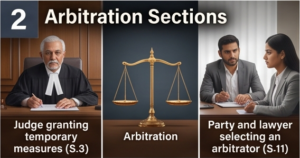
Section 9 of the Arbitration and Conciliation Act, 1996 allows a party to approach a court for interim measures, such as securing the amount in dispute, preserving property, or restraining a party from dealing with assets, either before arbitral proceedings begin, during them, or after an award but before it is enforced. It exists because arbitral tribunals are not always in a position to grant urgent relief quickly, particularly before they are even constituted.
Section 11: Appointment of Arbitrators
When parties cannot agree on an arbitrator, or when one party refuses to appoint one as required by the arbitration clause, Section 11 allows the other party to approach the High Court, or the Supreme Court in international commercial arbitration, to have an arbitrator appointed. Courts at this stage generally confine themselves to checking whether a valid arbitration agreement exists, leaving substantive disputes to the tribunal itself.
Section 34: Challenging the Award
Once an arbitral tribunal has ruled, Section 34 sets out the limited grounds on which a party can ask a court to set aside the award, such as incapacity of a party, an invalid arbitration agreement, a breach of natural justice, or the award being in conflict with the public policy of India. It is not an appeal, and courts do not re-examine the merits of the dispute.
Why the Distinction Matters
Each of these provisions serves a different stage of the arbitration lifecycle, interim protection, getting the process started, and limited post-award review. Confusing them, for instance treating Section 34 as a chance to re-argue the case, is one of the most common and costly mistakes parties make in arbitration-related litigation.
This note is prepared by our Dispute Resolution team. If you are dealing with a related situation, get in touch with us.
← Back to all Insights