Disclaimer & Confirmation of User
As per the rules of the Bar Council of India, advocates and law firms are not permitted to solicit work or advertise. By clicking “I Agree” below, the user acknowledges and confirms that:
- there has been no advertisement, personal communication, solicitation, invitation or inducement of any kind from Anshul Dutt & Co. or its members to solicit any work through this website;
- the user wishes to gain information about the firm for his or her own information and use;
- the information is made available only at the user’s request and is for informational purposes only, and should not be construed as advertising or solicitation;
- no information on this website is to be construed as legal advice, and the firm is not liable for any action taken in reliance on it;
- nothing on this website creates a lawyer–client relationship.
Constitutional Law
Filing a Writ Petition Under Article 226: When the High Court Will Intervene
The scope of writ jurisdiction, and when it is the right remedy against state action.
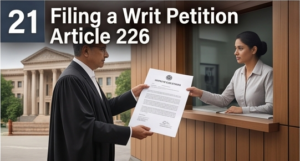
This article is general information only, not legal advice, and not solicitation of work. It should not be relied upon as a substitute for advice on your specific facts.
The Scope of Article 226
Article 226 of the Constitution empowers every High Court to issue writs, including habeas corpus, mandamus, prohibition, quo warranto, and certiorari, not only for enforcement of fundamental rights but for any other purpose, giving High Courts a wider writ jurisdiction than the Supreme Court’s under Article 32, which is confined to fundamental rights.
When a Writ Petition Is the Right Remedy
Writ jurisdiction is generally invoked against the state or a public authority, for instance to challenge an arbitrary administrative order, compel a public authority to perform a statutory duty, or quash an order passed without jurisdiction or in breach of natural justice. It is far less suited to disputes that are essentially private in nature, or where a specific alternative remedy, such as an appeal or tribunal, already exists.
The Alternative Remedy Bar
Courts often decline to entertain a writ petition where an equally efficacious alternative remedy is available, such as a statutory appeal, though this is a rule of discretion rather than an absolute bar. Exceptions are made where the order under challenge is wholly without jurisdiction, violates natural justice, or infringes a fundamental right, in which case a writ petition may proceed despite an available alternative.
What Makes a Writ Petition Effective
A well-drafted petition identifies precisely which statutory duty or fundamental right has been violated, sets out the specific order or inaction being challenged, and, where urgent, makes a clear case for interim relief. Petitions that are framed too broadly, or that essentially ask a court to reassess factual or policy decisions rather than legal ones, rarely succeed.
This note is prepared by our Constitutional Law team. If you are dealing with a related situation, get in touch with us.
← Back to all Insights